In short: most Luxembourg SMEs should start with a bias toward buying. The reason is not that building is wrong. The reason is that buying exposes the real workflow faster, with less ownership risk, and with clearer evidence about what still needs to be customised.
The useful framing is simple. This is not a referendum on whether the company is ambitious or innovative enough. It is a decision about where complexity should live, who owns it after launch, and whether the workflow is standard operating work or a capability the business genuinely needs to own.
Default rule
Buy first. Learn fast. Build only where the evidence survives.
For most SMEs, the safest sequence is to buy the standard layer, observe where the real constraints and exceptions live, and only then commission custom logic for the narrow part the vendor cannot carry.
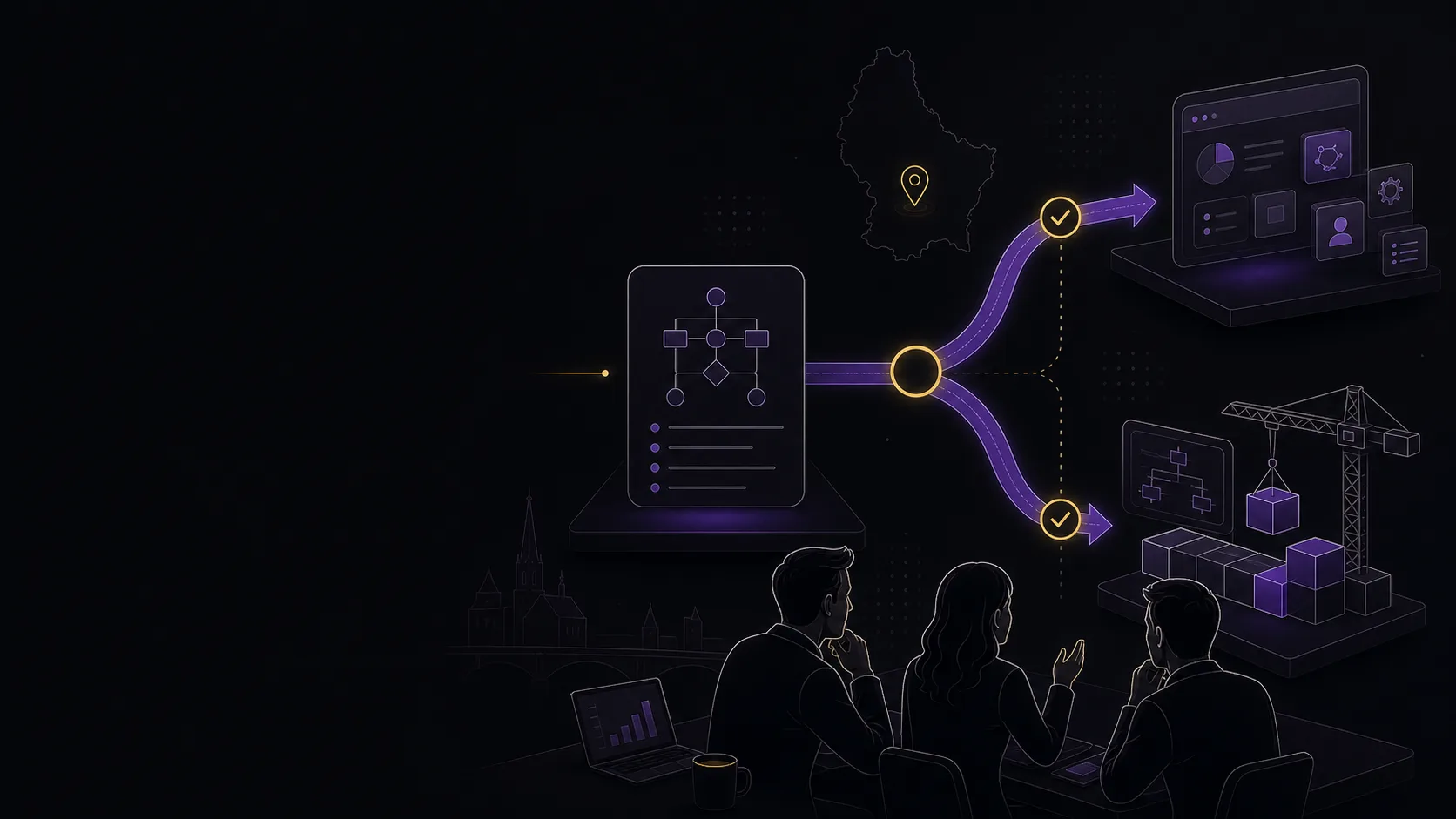
Buy the standard layerLearn from real usageBuild only the surviving gap
Step 1
Clarify the workflow first
Write down the inputs, the approvals, the exceptions, and the owner. If the team cannot describe the process plainly, it is too early to decide.
Step 2
Buy the standard layer next
If the market already solves most of the workflow, use that speed. Real usage will show whether anything still deserves custom work.
Step 3
Build only the surviving gap
Commission custom logic only where the process is truly distinctive, the control rules are non-negotiable, or the capability is worth owning.
Management moment
Most teams start arguing about build versus buy after they have already decided to "do something with AI" and before they have described the workflow clearly enough to justify either path.
That is the real trap. The company is not choosing between two technologies. It is choosing where to place operational complexity before it understands the shape of the work.
Why SMEs Get Stuck Choosing Between Build and Buy
The build-versus-buy argument usually arrives too early. Leadership has committed to exploring AI, the team feels pressure to move, and the workflow still exists as a set of assumptions instead of a documented process. That creates a false choice. The business begins to debate the execution model before it has earned a clear brief. If the team has not yet defined the first workflow, owner, data boundary, and scorecard, start with AI readiness for Luxembourg SMEs before comparing tools or custom build options.
Luxembourg SMEs feel this more sharply than larger organisations. Teams are lean, technical ownership is often partial or external, and a weak decision costs more than licence fees. It costs management attention, confidence, and another quarter of hesitation.
In practice, this means the wrong choice usually fails twice. First, the company spends time arguing at the wrong altitude. Then it spends more time undoing the consequences of a decision that was made before the team had enough operational clarity to support it. That is why the best build-versus-buy process feels slower in week one and much faster by quarter end.
The adoption data points the same way. According to Eurostat's 2025 survey on AI use in enterprises, 19.95% of EU enterprises used AI technologies in 2025, but adoption is sharply uneven: 55.03% of large enterprises versus only 17% of small enterprises. The most common reason SMEs that considered AI did not adopt it was lack of relevant expertise (70.89%), followed by uncertainty about legal consequences (52.52%). That gap is the operational reality behind build-versus-buy. Most SMEs do not have the in-house expertise to own a custom build, so buying the standard layer is usually the lower-risk first move, and the small-enterprise adoption gap is not an ambition problem, it is an ownership-cost problem.
What leaders usually debate
Cost, ambition, vendor trust, technical elegance, and whether building sounds more strategic.
What they should debate
Where the exceptions live, who will own the workflow after launch, and whether the process belongs in standard software or company-owned logic.
This sits next to hire, outsource, or automate. Build versus buy is only one execution choice inside a wider capacity decision.
The practical consequence is that the build-versus-buy process must be stronger than the personalities in the room. A finance-led instinct to contain spend can make a real build case look impossible. An innovation-led instinct to create something proprietary can make a buy case look timid. The workflow has to win that argument.
How we treat this at MonyTek
We treat build-versus-buy as a readiness question, not a technology question. Before a team compares vendors or scopes a custom build, we ask them to describe one workflow in plain language: the inputs, the exceptions, the approvals, and the owner after launch. If that description is still fuzzy, the right first move is neither buy nor build, it is readiness. Once the workflow is legible, the small-enterprise ownership gap Eurostat reports usually answers the question on its own. A lean Luxembourg team that cannot yet describe its own exception path should not be asked to own custom software. It should buy the standard layer, learn from real usage, and only then commission the narrow piece that survives.
What Building Actually Means for an SME
For most SMEs, building does not mean creating a giant internal product team. It usually means commissioning a narrow workflow, integration layer, or internal tool because the market does not solve the work cleanly enough. That can be the right decision, but only when the company is clear about what it is choosing to own.
A build case is real when the logic itself matters. That might be a document routing sequence with Luxembourg-specific compliance rules, a client intake flow with unusual approval logic, or a pricing process where the edge cases are the actual business.
Build is justified when
The workflow itself creates competitive advantage rather than supporting generic operations.
The process handles data, approvals, or controls that cannot comfortably live in a vendor environment.
The edge cases are not edge cases at all. They are the real workflow.
Someone in the company can govern the system after launch instead of depending forever on the original builder.
The hidden obligation
Building is not just a project cost. It is a commitment to maintenance, debugging, future changes, and knowledge transfer after delivery. If the original builder disappeared tomorrow and nobody in the business could govern the system within two weeks, the company is underestimating the ownership risk. That is the same trap described in using AI without an internal AI team.
That does not mean building should be feared. It means the business should budget for governance with the same seriousness it budgets for implementation. A good build case is usually small, well-scoped, and owned by one named business process rather than justified as a broad innovation project.
What Buying Actually Means for an SME
Buying is not the lazy answer. It is the fast answer when the workflow is standard enough, the business needs progress quickly, and nobody should be responsible for owning custom software yet. The value of buying is speed, support, and a lower maintenance burden.
The risk of buying appears when the company chooses a tool before it understands the approvals, exceptions, and responsibilities inside the process. That is why many failed SaaS rollouts are not software failures. They are workflow failures disguised as software projects.
Buying is safer when
The workflow looks like standard CRM, reporting, document handling, task routing, or admin operations.
Leadership needs a dependable result quickly, not a custom platform later.
No credible internal owner should be responsible for custom maintenance.
The requirement is still changing and the team needs to learn before it encodes assumptions into software.
This is why buying should be understood as a learning move as much as a software move. A well-chosen tool lets the team test where the workflow is stable, where it keeps breaking, and whether the issue is software, ownership, or workflow design. That evidence stays useful even if the company later decides to commission a custom layer.
The common buy mistake
Teams buy a platform that covers most of the workflow, then bury the remaining edge cases in manual workarounds. Over time, the workaround becomes the real process and the software becomes overhead. Before buying, map the workflow end to end and verify that the tool covers the steps that create real delay, risk, or rework. This is the same execution failure pattern described in AI interest versus execution.
The Decision Framework: Five Criteria That Actually Matter
Do not debate build versus buy in the abstract. Score one specific workflow against the five criteria below. If most answers sit on the buy side, buy. If one narrow layer keeps falling into the middle, buy the core and customise that layer. Build only when the same workflow keeps landing on the build side for the same reasons.
This matters because executive teams often bundle several workflows into one discussion. Reporting, document review, onboarding, and pricing logic may all get discussed as one "AI project" even though each has a different ownership and risk profile. Run the framework on one workflow at a time or the result will be too fuzzy to trust.
Decision guide
Read the workflow down the page. Do not solve it in the abstract.
Each criterion below should make the choice narrower. If most answers sit on the buy side, buy. If only one layer keeps landing in the middle, buy the core and customise that layer. Build only when the company keeps hitting the same build-side signal for the same workflow.
01
Workflow shape
Is the process already solved in mature software, or is the custom logic itself the work?
Leans buy
The workflow is standard and repeatable.
Leans hybrid
Most of the flow is standard, but one part is not negotiable.
Leans build
The core logic is specific to how the company operates.
02
Time pressure
How fast does the business need a dependable result?
Leans buy
The business needs something this quarter.
Leans hybrid
The team can pilot now and customise only what survives.
Leans build
A slower path is acceptable because the owned capability matters.
03
Ownership capacity
Who will maintain, improve, and troubleshoot the workflow after launch?
Leans buy
There is no credible internal owner for custom software.
Leans hybrid
An operational owner exists, but technical work should stay narrow.
Leans build
The company can genuinely own the system after delivery.
04
Data constraint
Can the workflow safely live inside a vendor environment?
Leans buy
Vendor hosting and controls are acceptable.
Leans hybrid
Only part of the workflow can leave the company.
Leans build
Data, control, or approval rules must stay inside your environment.
05
Strategic value
Is the workflow plumbing, or is it part of the company’s advantage?
Leans buy
It is useful infrastructure, not differentiation.
Leans hybrid
The process matters, but only one layer is strategic.
Leans build
Owning the capability protects how the business wins.
Useful default
If the framework still gives you a tie, buy first. Buying teaches you what the workflow actually needs before you spend leadership attention on custom logic. Once you have a shortlist of buy candidates, score each vendor against fit, data handling, workflow support, implementation effort, and proof before signing.
For the structured version of that scoring, use the AI vendor evaluation framework for Luxembourg SMEs; it converts fit, data handling, and workflow support into a checklist a small team can run inside one week.
Luxembourg Context: Funding, Support, and Market Reality
Luxembourg changes the economics of this decision because public support exists for both routes. SME Package - AI covers up to 70% of eligible costs for AI projects between EUR 3,000 and EUR 25,000 (Source: Guichet SME Package - AI). Fit 4 AI supports broader readiness, governance, and roadmap work (Source: Luxinnovation Fit 4 AI).
That means the business can reduce risk on either path. A contained custom workflow might become financially sensible where it otherwise would not. A purchased platform with rollout support might become easier to justify where leadership expected hidden implementation cost.
But funding should not choose for you. The execution model should match the workflow first. Funding is a derisking lever, not a strategic argument. A funded bad decision is still a bad decision. For the programme map behind that logic, read AI solutions for Luxembourg SMEs in 2026 and then the narrower funding breakdown in Luxembourg AI funding for SMEs.
What funding changes
It lowers the cost of testing one path. It does not remove the need to decide whether the workflow belongs in vendor software or in company-owned logic.
Local constraint that matters
Many Luxembourg SMEs handle cross-border client data under GDPR. If the vendor cannot satisfy residency, access, or control requirements, building or an EU-controlled hybrid may become the safer route.
This local context matters because many Luxembourg SMEs operate across languages, jurisdictions, and client expectations at the same time. A workflow that looks straightforward in a vendor demo can become much more complex once multilingual documents, approval chains, and cross-border handling requirements enter the real operating environment.
Three Luxembourg Scenarios: Build, Buy, and the Middle Path
The framework becomes easier to trust when you see how different workflows land in different places. These examples reflect common patterns across Luxembourg advisory, professional services, and logistics-adjacent SMEs.
Scenario oneHybrid
Document-heavy onboarding with local compliance checks
A financial advisory team needs smoother onboarding, but the Luxembourg-specific approval logic still matters. Buy the document and workflow core, then build the thin compliance layer that the vendor cannot carry cleanly.
Scenario twoBuy
Weekly reporting across standard tools
A professional services firm wants one reliable management report from tools it already uses. This is usually a buy or configure case, not a custom build case.
Scenario threeBuild
A proprietary pricing engine for a logistics SME
The company prices work using margin logic and decision rules that are central to how it wins. That is a real build case because the capability itself deserves ownership.
Notice the pattern. Most bottlenecks look like the first or second scenario, not the third. Many teams talk themselves into a build case because custom work sounds strategic. In practice, the true build case is narrower and easier to recognise.
When Neither Build nor Buy Is the Right First Step
The most expensive mistake is committing before the workflow is clear enough to evaluate. If leadership cannot describe the inputs, steps, exceptions, outputs, and ownership in plain language, the business is too early for both a real build decision and a serious tool selection decision.
What to do instead
Map the workflow honestly, including the messy exceptions.
Name the actual bottleneck: speed, quality, consistency, visibility, or compliance.
Define the desired outcome in one sentence and assign an owner.
Only then choose whether the answer is buy, hybrid, or build.
This sequencing prevents the classic SME failure mode: buying software that demos well but does not match the real process, or building a custom system for a problem that turns out to be ownership or governance rather than technology. The discipline of mapping the process first is the same principle behind safe process automation and disciplined automation ROI evaluation.
For many teams, this is the most important conclusion in the article. The first useful decision may be neither buy nor build. It may be to make the workflow legible enough that the eventual call can be made with evidence rather than instinct.
Frequently Asked Questions
Should a Luxembourg SME build custom AI tools?
Only when the workflow is genuinely unique, the data or control requirements rule vendors out, or the capability itself creates competitive advantage. For most standard processes, buying first is the safer default.
Can SME Package - AI support a build project?
Yes. According to Guichet, SME Package - AI can cover up to 70% of eligible costs for projects between EUR 3,000 and EUR 25,000, whether the company builds a contained custom workflow or buys and configures an existing AI tool.
What if the leadership team cannot agree on build versus buy?
Use the five-criteria framework in this article. If the result is still a tie, buy first and use real workflow evidence to determine whether any custom layer is still necessary.
Is a hybrid path usually more realistic than pure build?
Often yes. Many SMEs should buy the standard operating layer and build only the narrow piece where their workflow, compliance requirement, or decision logic genuinely diverges from the market.
The Next Step
Suggested next step
If your team is debating build versus buy, do not start with vendor demos or technical proposals. Start by mapping one real workflow end to end, then score it against the five criteria in this article. That will make the right execution model visible much faster.
 Maroun AlteklyFounder of MonyTek · Luxembourg SME consulting