A team member pastes client notes into ChatGPT to summarise a meeting. Another uploads a supplier contract to an AI tool nobody approved. A third asks whether the draft proposal AI generated can go straight to the client. Three people, three tools, three different standards — and nobody in leadership knows it is happening yet.
In short: AI governance for Luxembourg SMEs should start as a short operating system for the first pilot: approved tools, data boundaries, human review, workflow ownership, and escalation. The goal is not enterprise bureaucracy. The goal is to let the company test AI without turning confidential data, client communication, or management decisions into unmanaged experiments.
A manager asks whether AI can summarise client notes. A salesperson wants help rewriting a proposal. An operations lead wants to analyse internal complaints. These are not the same governance question.
4
decisions before the first prompt
5
rules that fit one team meeting
1
page of governance to start
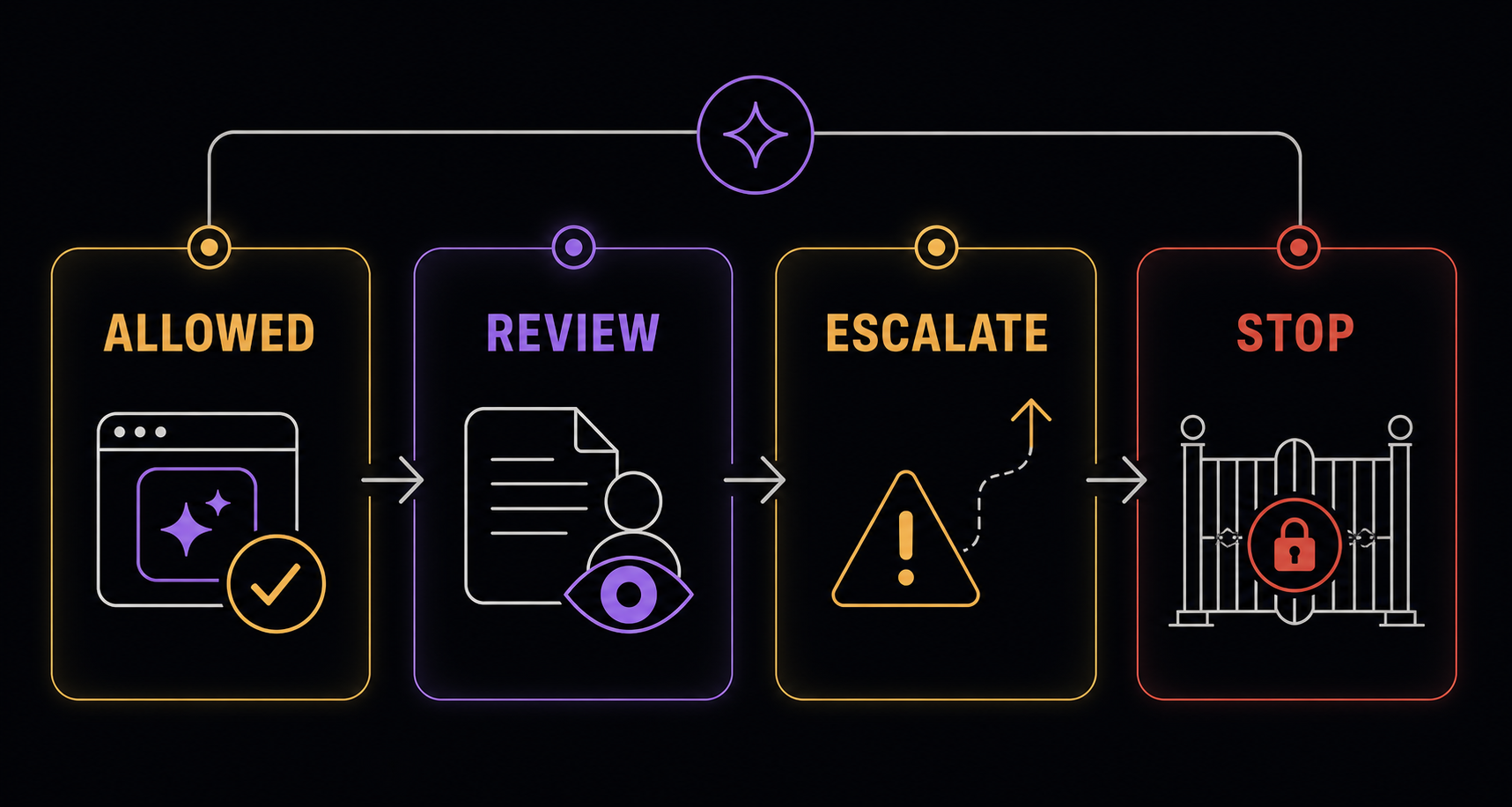
Use this as a sorting rule, not a process checklist. Each AI use case should land in one lane before the pilot starts.
The First AI Pilot Needs A Control Room
The current search results for AI governance are split between policy pages, AI Act explainers, programme pages, and broad SME adoption guidance. That context is useful, but it often feels too large for a founder-led company preparing one practical pilot. A Luxembourg SME does not need to copy enterprise governance before testing AI. It needs a control room for the specific workflow it is about to touch.
Control room means four things are visible before anyone starts: what tool is allowed, what data is excluded, who reviews output, and who owns the business result. Without those four decisions, AI spreads through the company as private habit. People use different tools, paste different data, and apply different standards. Nobody can say whether the risk is acceptable because nobody can see the workflow.
Without governance
Every team picks its own AI tool
Client data pasted into unapproved platforms
No one checks AI output before it reaches the client
Governance is a document nobody reads
With governance
One approved tool for the pilot
Data boundaries defined before the first prompt
Named reviewer for every client-facing output
Governance changes team behaviour weekly
Invisible use
people experiment alone, often with good intentions but different standards
Visible use
the company can name the workflow, owner, tool, data boundary, and review point
Governed use
the pilot has evidence that AI improved the work without weakening control
This is why governance belongs next to readiness. The article on practical AI adoption for Luxembourg SMEs explains how to choose the first workflow, owner, data boundary, and scorecard. Governance adds the operating rules that keep that pilot from drifting once real people start using real tools.
Example: proposal support
Imagine a commercial team wants AI to help draft first-pass proposals. The use case looks harmless, but the governance questions are concrete. Which tool is approved? Can client notes be pasted into it? Who checks that claims, deadlines, scope, and pricing are accurate before the proposal leaves the company? If the team cannot answer those questions before the pilot, the pilot is not only a productivity test. It is an uncontrolled client-communication test.
The minimum decision list
Approve one tool for the pilot instead of letting every team member choose privately.
Name the data categories that are excluded before the first prompt is written.
Assign one workflow owner who can decide whether the result is useful enough to keep.
Define the human review point before AI output becomes client-facing or decision-facing.
The Five Governance Rules To Write First
Most SMEs should not begin with a long AI governance manual. They should write five short rules that a manager can explain in a team meeting. If a rule cannot change behaviour, it is not governance yet. It is a document.
01
Tool rule
Which AI tools are allowed today?
If a team member cannot name the approved tool list, AI use is already unmanaged. Start by allowing only the tools leadership can support, monitor, and explain.
02
Data rule
Which information may never be pasted into AI?
Separate public, internal, confidential, client, personal, and regulated data. The first policy should make the restricted categories impossible to miss.
03
Review rule
Which outputs need human approval?
Client communication, HR decisions, legal or compliance reasoning, pricing, and commitments should never move from AI output to action without a named reviewer.
04
Owner rule
Who owns the workflow, not just the tool?
Governance fails when everyone assumes AI belongs to IT. The workflow owner should own whether AI is useful, safe, and reviewed.
05
Escalation rule
Where does uncertainty go?
If staff do not know where to ask, they will guess. A simple escalation path is more useful than a long policy nobody reads.
If the company already has an internal AI policy, use that as the written base. The existing MonyTek guide on AI policy for Luxembourg SMEs gives the one-day policy structure. The governance layer turns that policy into a pilot habit: approve, review, escalate, learn, and decide what can scale.
How Luxembourg Support Fits The Governance Work
Luxembourg has useful AI support routes, but support does not replace internal responsibility. Guichet's SME Package - AI guidance helps SMEs understand eligible AI project support. Luxinnovation's AI guidance for SMEs points companies toward clearer use cases and adoption pathways. Those resources are more useful when the company already knows the workflow and governance boundary it wants to test.
The European AI Act also matters, but the first SME question is usually operational rather than legal: can the business show that AI use is owned, reviewed, and appropriate for the workflow? The EU AI Act guide for Luxembourg SMEs covers regulatory timing. This article focuses on the management layer that should exist before the first practical pilot starts.
A support programme still needs an internal owner
This is the point many SMEs miss when they move from curiosity to funded action. A support programme can help with cost, expertise, and confidence, but it cannot decide how the company handles client data, which outputs need review, or whether the workflow owner has authority to change the process. Those decisions sit inside the business. If they are not made before external support begins, the project can become a tool implementation without a management system.
A better sequence is to prepare the governance boundary first, then use public or partner support to make the pilot stronger. That means the SME can ask better questions: does this tool respect our data boundary, does this setup keep review visible, does this workflow owner have enough control, and does the pilot produce evidence we can use in the next leadership review? Governance turns outside help into a controlled business experiment rather than a procurement exercise.
Do not use public support to avoid the governance decision. Use it to accelerate a pilot the company can already explain.
A Simple Sequence Before The First Pilot
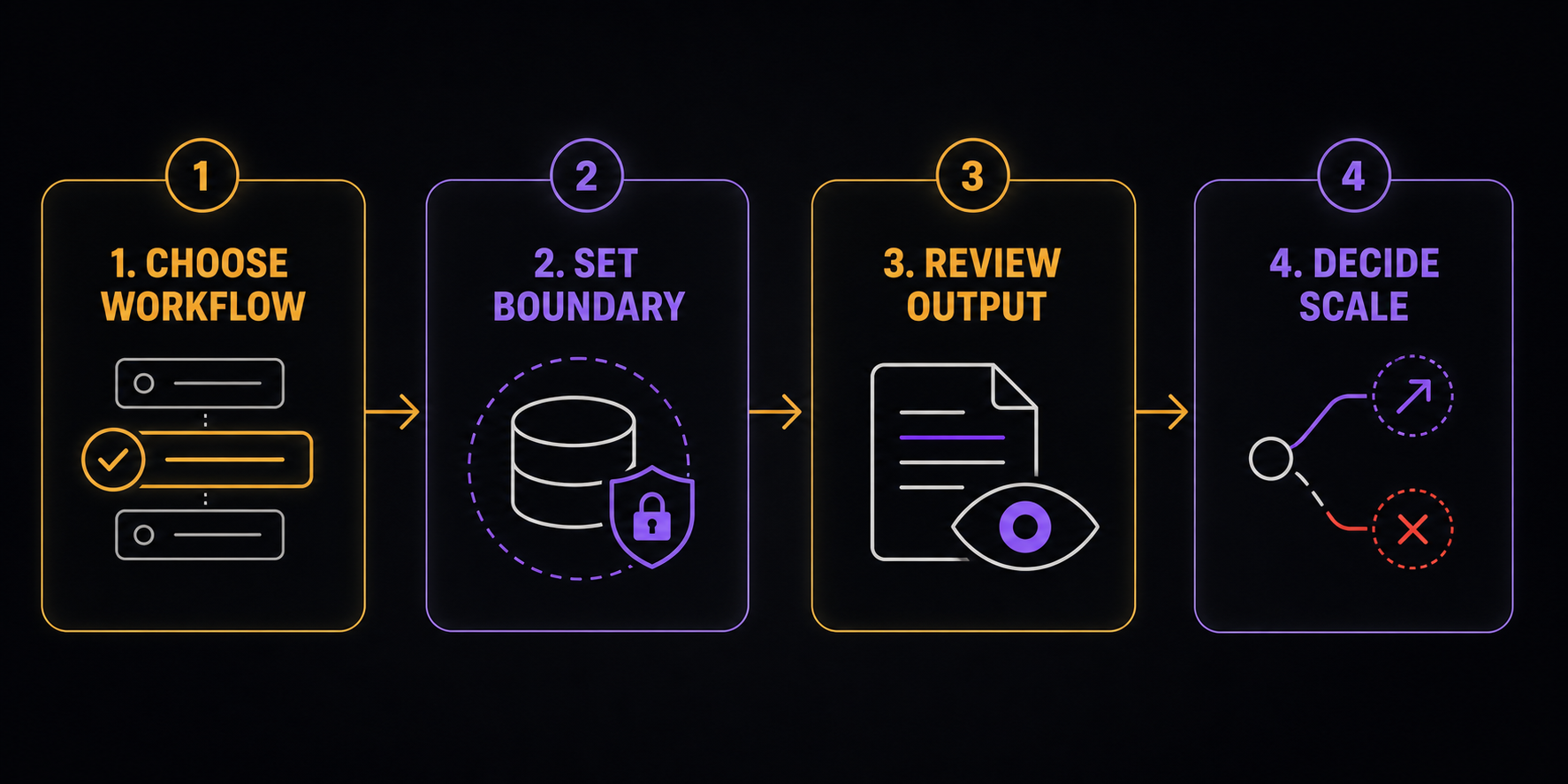
The first governance sequence should be short enough to use. If the process needs several committees before a low-risk pilot can start, the SME will route around it. If the process is invisible, the company has no control. The sequence below is the middle ground.
Read this as the minimum operating path: choose one workflow, set the boundary, review the output, then decide whether the pilot can scale.
1
Choose one workflow
Pick work that already happens every week: proposal drafting, internal search, meeting summaries, customer triage, or reporting. Do not start with a vague company-wide AI programme.
2
Write the boundary
State which tool is allowed, which data is excluded, which output needs review, and who owns the result. This should fit on one page.
3
Run the review loop
Review the first outputs for accuracy, confidentiality, usefulness, and adoption. The pilot should teach governance, not only productivity.
4
Decide what scales
Scale only if the workflow became faster or better without weakening control. If governance depends on constant rescue, the pilot is not ready.
This sequence also prevents a common mistake: treating AI governance as a blocker after the pilot already exists. Governance should shape the pilot before the tool is selected. If the first workflow belongs to a non-technical team, the guide to using AI without an internal AI team shows why local context, file boundaries, and review habits matter before teams connect broader systems.
What to document after the pilot
The pilot should leave behind a small evidence trail. That evidence is more valuable than a long slide deck because it tells leadership whether the company learned something transferable. It also helps the next team avoid repeating the same governance questions from zero. The next layer is deciding where approval proof should live so the evidence stays usable after the pilot.
Evidence item
What to record
Workflow tested
Name, team, frequency before the pilot
Tool approved
Which tool, version, who authorised it
Data excluded
Categories blocked before the first prompt
Reviewer named
Who checked output before action
Speed / quality change
Measurable difference vs the manual process
Risk observed
Anything unexpected that appeared during use
The decision at the end
The pilot should end with a management decision, not a vague feeling that AI was interesting. Leadership should decide whether the workflow is approved for wider use, needs a second limited test, should be paused, or should be rejected because the control burden is too high.
Approved
Continue with current boundary
Limited test
One adjustment, then another cycle
Paused
Risk or burden not yet understood
Rejected
Control burden too high
That decision gives the team confidence because the pilot has a visible outcome. It also prevents AI from becoming a collection of private experiments that nobody owns.
The same discipline matters when the business later decides whether to buy an existing tool or build something more specific. The guide to AI build versus buy for Luxembourg SMEs covers that execution choice. Governance should come before that choice because it defines the boundaries any tool must respect.
The first governance review should be practical enough to fit into a normal leadership meeting. Start with the workflow owner.
The first governance review agenda
The first governance review should be practical enough to fit into a normal leadership meeting. Start with the workflow owner. Ask what changed in the work, where AI helped, where human correction was needed, and whether any data boundary felt unclear. Then ask the reviewer what they had to check before accepting the output. If the reviewer repeatedly corrected the same issue, the team needs a better prompt, a better rule, or a clearer input structure before scaling the pilot.
1
Workflow review
What changed, where AI helped, where human correction was needed
2
Adoption check
Did people use the approved workflow, or route around it?
3
Next decision
Continue, tighten, expand, or stop the pilot
The second part of the review should focus on adoption. Did people actually use the approved workflow, or did they route around it because it felt too slow? If staff avoided the process, the governance is too heavy or the tool does not match the work. If staff used other tools privately, the approved boundary was not communicated clearly enough. Governance has to protect the business, but it also has to be usable by the people doing the work every week.
The third part should focus on the next decision. Leadership should decide whether the same workflow continues, whether the rules are tightened, whether the use case expands to another team, or whether the pilot stops. The point is not to create perfect governance in one cycle. The point is to create a repeatable management habit: test one workflow, review the evidence, improve the boundary, and only then decide whether AI should move deeper into the business.
The simplest scoring method
The simplest scoring method is enough for the first month. Give the pilot a green, yellow, or red signal for usefulness, data safety, review effort, and adoption. This avoids vague enthusiasm and makes AI adoption a sequence of management decisions.
Signal
Green
Yellow
Red
Usefulness
Workflow clearly faster or better
Some improvement, unclear data
No measurable gain
Data safety
No boundary crossed
One unclear situation
Data boundary violated
Review effort
Reviewer checks same or less
More correction than expected
Output unreliable without heavy correction
Adoption
Team uses approved workflow consistently
Some workarounds
Staff avoid the process
That score should be visible to the people using the workflow. If the pilot is green, they know the behaviour is approved. If it is yellow, they know what must change. If it is red, they know the company is not rejecting AI as a whole, only this workflow in this form. That distinction matters because it keeps governance from becoming fear-based. The team learns that good AI use is encouraged when the work is owned, reviewed, and bounded.
Keep the first version deliberately modest. A one-page boundary, one owner, one review meeting, and one decision log are enough for most SMEs to learn safely. The danger is trying to solve every future governance question before the company has tested one real workflow. Good governance starts small, but it makes the next decision easier because the company can point to evidence instead of opinion.
References
Public references are included where they help readers verify Luxembourg AI support context and regulatory background. The article's recommendation is operational: keep the first governance system short, visible, and tied to one pilot workflow.
Frequently Asked Questions
What is AI governance for a Luxembourg SME?
AI governance is the practical set of rules that makes AI use visible, owned, reviewable, and safe enough for the company stage. For most SMEs, it starts with approved tools, data boundaries, review points, and escalation.
Does an SME need AI governance before the first pilot?
Yes, but it should be light. A first pilot needs enough governance to protect data, assign ownership, and define review. It does not need a large enterprise committee before any learning can begin.
How is this different from an internal AI policy?
An internal AI policy states the rules. AI governance is the operating habit around those rules: who owns them, when review happens, what gets escalated, and how the company decides whether a pilot can scale.
What should be avoided in the first AI pilot?
Avoid sensitive personal data, confidential client material, automated decisions that affect people, and workflows nobody owns. Start where the business can learn quickly without creating unmanaged risk.
Next Step
Suggested next step
If AI use is starting informally, the next step is to choose one workflow and write the governance boundary before tools spread. The work should connect readiness, policy, review, and the first measurable pilot.
 Maroun AlteklyFounder of MonyTek · Luxembourg SME consulting